Instructor-led workshop for organisations · Business functions
5-Day Enterprise AI Solutions Bootcamp
Design, Build and Test Enterprise AI Solutions for Business Operations
Over five days, participants choose one procurement problem, build a limited AI solution prototype for it, test it on realistic cases, and prepare a controlled deployment plan. Each day includes a practical simulation. Participants learn to check AI outputs before people make procurement decisions. Deployment is simulated; no solution goes into live operation during the programme.
Who should attend
Procurement, category and contract managers, tender committee members, operations and process owners, and the governance, audit, IT and data staff who build and oversee AI solutions for them. Public and private sector.
Length
Five days, in person.
Delivery
In person, led by a facilitator. Participants practise workplace decisions on StepSim, the AIR APAC decision simulator built by Exeter Labs.
Participants receive
A Record of Completion for each participant who completes the programme. A separate, optional assessment can lead to certification under AIRS-J/1, the AIR APAC Standard for Judgment in AI-Enabled Work. The certification is valid for two years and verified free on a public register. AIRS-J/1 is AIR APAC's own credential. No regulator, university or professional body recognises it.
Run for your group, with case files written for your sector. Dates are agreed in the proposal.
AI can now draft specifications, compare bids, screen suppliers, flag contract risk and summarise spend. Each of these can make the work faster, and each moves a decision closer to a recommendation that no one checks.
In procurement, an unchecked decision is a cost, a legal risk and sometimes an integrity risk. A solution that is designed, built and deployed without that check repeats the same mistake at scale.
What makes it different
Participants use AI to do the work, then check it
Most AI courses teach either how to use the tools or the risks of using them. This programme does both on the same task, in the same session.
Using AI
Tasks participants do with an AI assistant
Map a procurement process and choose where AI should work.
Use AI to draft specifications, summarise supplier information and prepare bid comparisons for a person to review.
Build one limited AI-assisted workflow for the procurement problem the team chose.
Summarise a draft contract and list the clauses to review.
Write the rollout plan and the recommendation paper for the steering committee.
Checking AI
What they learn to check before acting
Find requirements in a specification that unfairly favour one supplier.
Check a ranking against the criteria and weights the tender actually published.
Ask what the solution could not see: a missing document, a related company, an integrity concern.
Test the solution on realistic cases, including test cases designed to expose its failures.
Record what AI drafted, what a person changed, and who approved the decision.
Outcomes
By the end, participants can
Find where AI improves each stage of the procurement cycle and choose one process worth building a solution for.
Design an AI solution for that process: the data, the steps AI performs, the decisions a person keeps, and the governance around it.
Build a working AI-assisted workflow and test it on realistic procurement cases before it reaches users.
Set the controls, approvals, disclosure and records that make the solution auditable.
Plan the rollout, run the first weeks of operation in simulation, and present the go-live decision to a steering committee.
What participants take back to work
A working AI solution prototype for one procurement process, with its test results.
A supplier and bid checking list for AI-produced screens and comparisons.
A decision record they can use for their own next award.
A control set for the solution: who approves, who checks, what is disclosed and what is recorded.
A rollout plan, and one named action with an owner and a date.
For the sponsor
What your organisation receives
Five days: a working AI solution prototype with its test results and control set, a rollout plan, a report for the sponsor, and a manager review within ten working days.
Agenda
How it runs
STEP (Structure, Test, Engage, Perform) is the method every AIR Academy programme teaches. It is four questions a manager asks before acting on an AI answer. The four questions come from AIRS-J/1, the AIR APAC Standard for Judgment in AI-Enabled Work.
The workshop runs over five consecutive days. It includes five team simulations, one each day, and two StepSim Practice missions, one at the start and one at the end, to compare how the group decides. Each activity produces a decision record, a test result or a piece of work the group keeps. Teams set the governance requirements when they choose and design their solution, then test and improve those controls on Day 4.
Participants use an AI assistant their organisation permits to do procurement tasks on fictional case files. They then check the outputs against the case evidence, the published criteria and the governance rules. The certification edition adds a separate assessment sitting after the five days.
Day and stage
Hands-on work and simulations
Day 1: frame the opportunity
Morning: an opening StepSim Practice mission, to record how the group decides before the programme. Map the procurement cycle and mark where AI already sits. Afternoon, simulation: a steering committee checks ten candidate AI uses for legal permission, data available, risk and value, and funds one small project the team can build in the week.
Day 2: design the solution and its controls
Morning: write the solution design: the data, the steps AI performs, the steps a person keeps, and the first controls: who approves, who checks, what is disclosed and what is recorded. Afternoon, simulation: a supplier tender in which the specification drafted with AI contains requirements that unfairly favour one bidder. Find them, correct them, and record why.
Day 3: build
Morning: using a prepared tool environment that needs no programming and fictional procurement data, each team builds one limited AI-assisted workflow chosen on Day 1, such as drafting a specification for review or comparing bids against the published criteria. Afternoon, simulation: each team tests its workflow against missing, inconsistent or misleading information that fits its task. Teams record the wrong outputs, the checks a person must make and the changes needed.
Day 4: test and govern
Morning: test the workflow on realistic cases, including test cases designed to expose its failures, and fix what fails. Afternoon, simulation: an internal audit and an integrity complaint against an award made with AI help. Test the controls set on Day 2 and improve them.
Day 5: deploy and decide
Morning, simulation: the first four weeks after deployment, with drift, a supplier challenge and a user who stops checking. Afternoon: present the go-live decision to a mock steering committee, then a closing StepSim Practice mission of the same kind as Day 1. One named action with an owner.
This programme runs as one five-day edition.
Cases
Fictional cases based on common procurement work and risks, written for the programme: a hospital equipment tender, an IT services contract, a facilities management renewal, a supplier integrity check. The bootcamp carries a regional case set: one Gulf public tender and one ASEAN private-sector sourcing decision. Where your country's procurement rules must apply, they are agreed with you and the case is reviewed by a procurement specialist before use. The cases are training material, not legal advice.
Built on
AIRS-J/1, the AIR APAC Standard for Judgment in AI-Enabled Work. The programme covers all four areas, applied to the procurement cycle: Structure at the need, Test at evaluation, Engage at approval and disclosure, Perform at award and contract.
See the simulator
What a StepSim Practice mission looks like
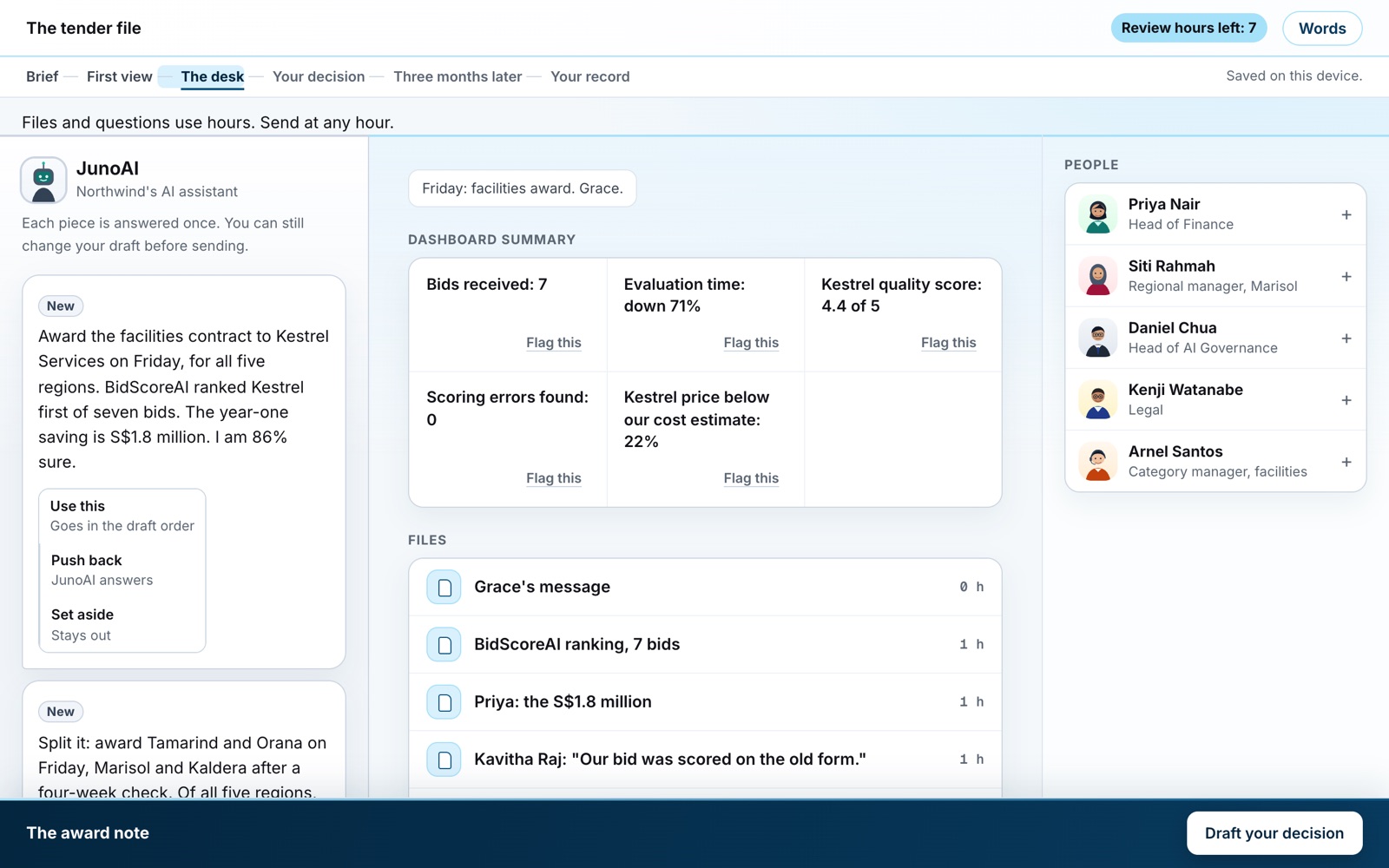
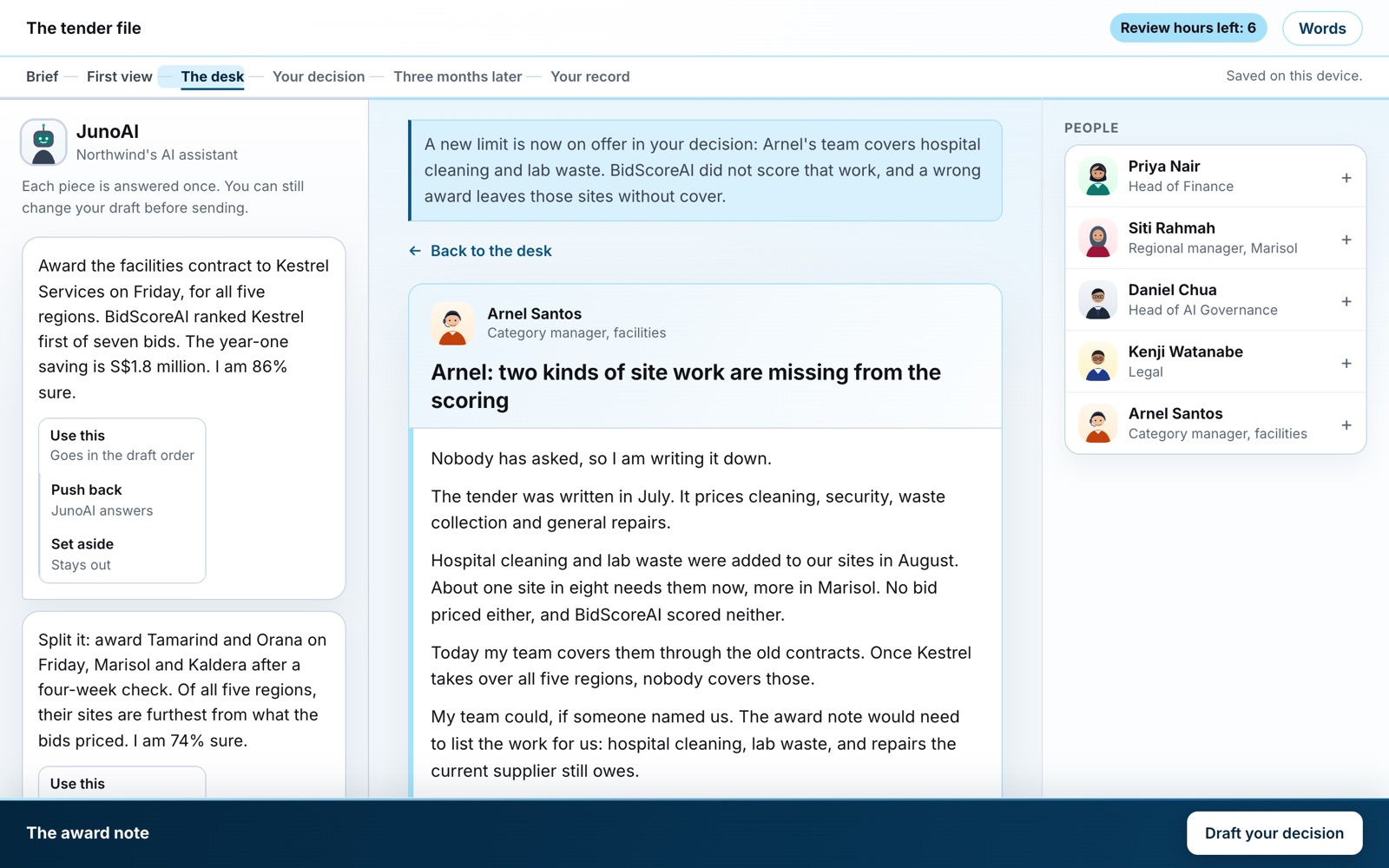
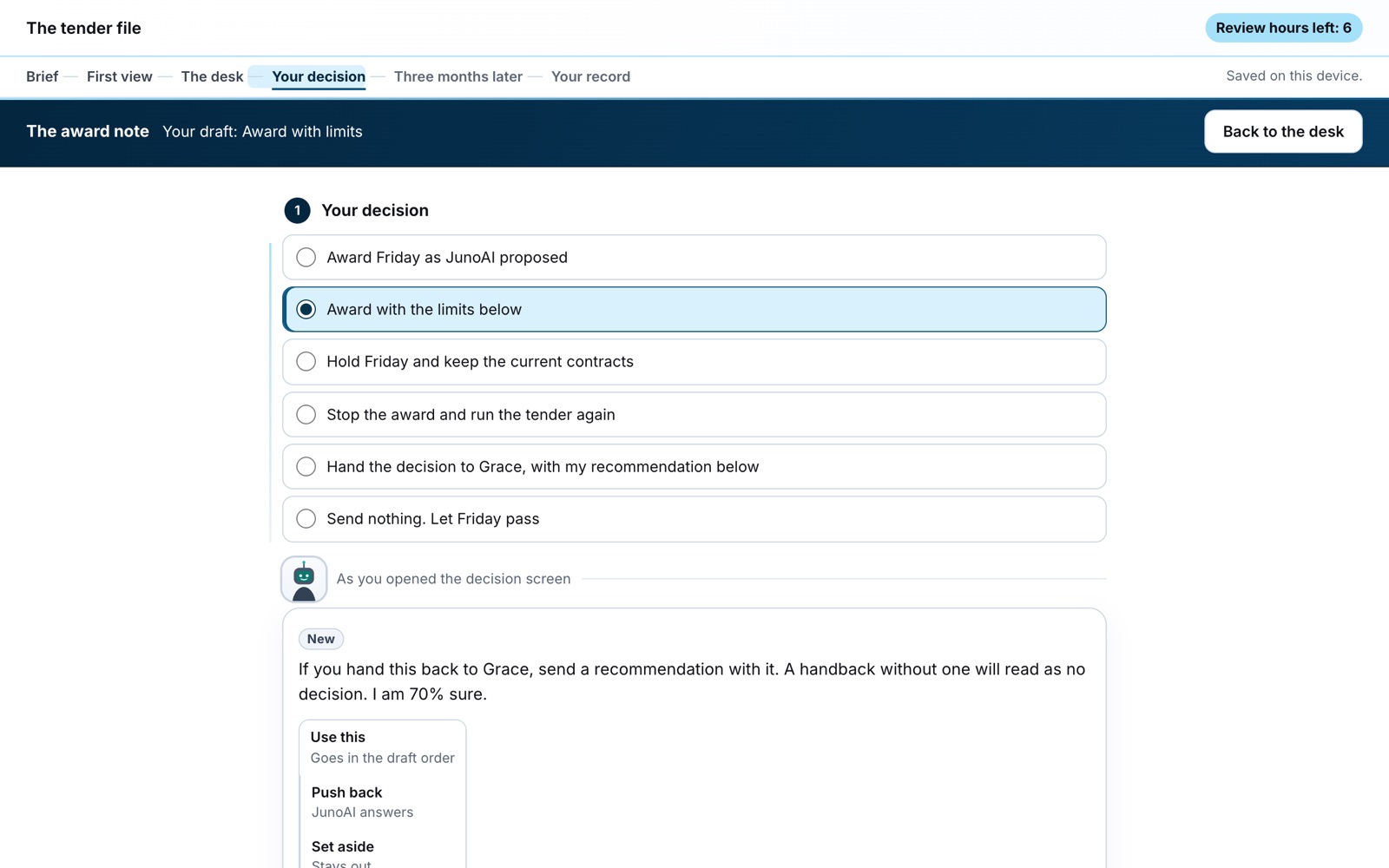
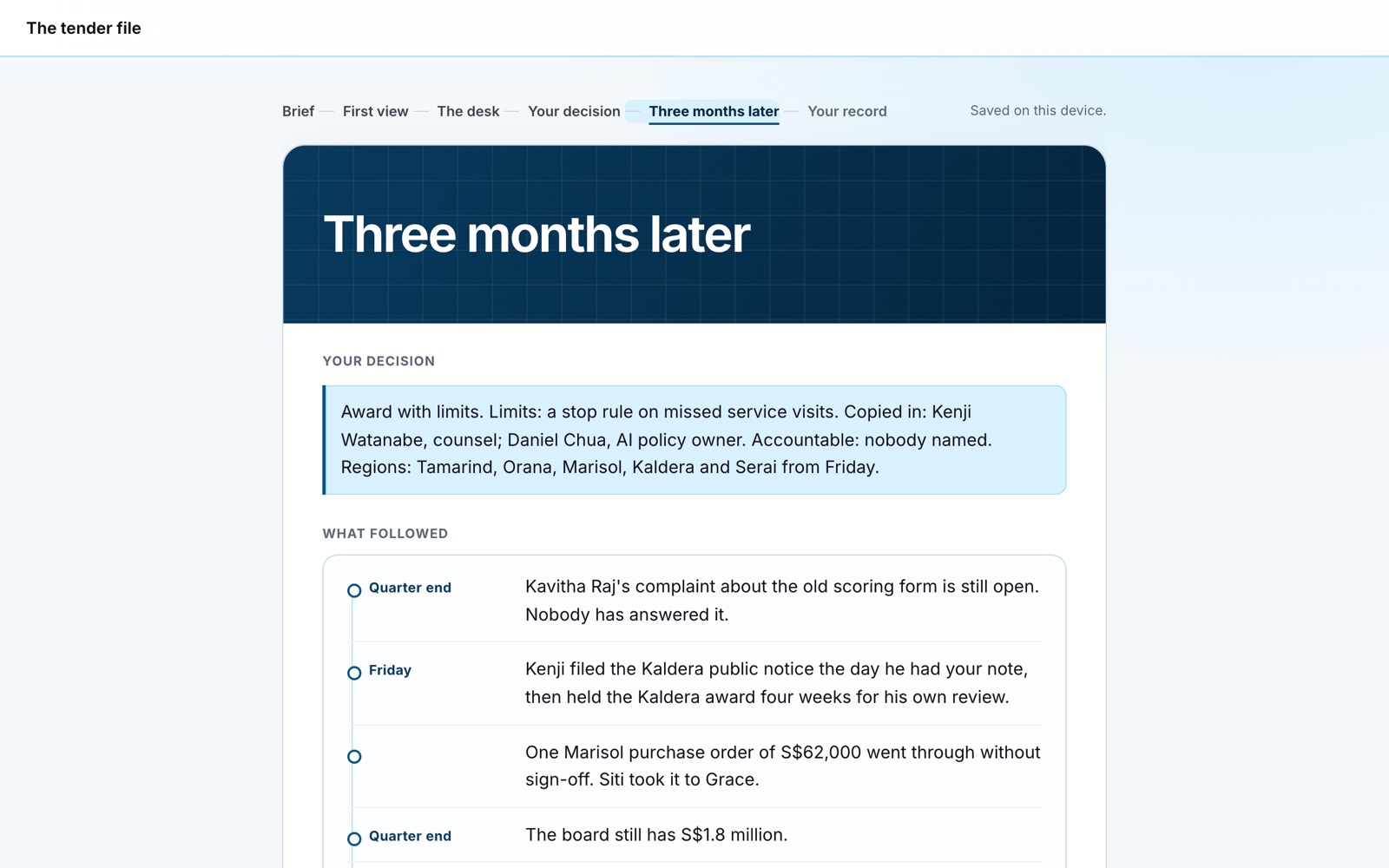
StepSim screens from The tender file, a procurement case set in a made-up company. A participant decides whether to award a contract after an AI tool has scored the bids. These screens show how participants check evidence and make decisions in StepSim. The bootcamp includes two StepSim Practice missions and five separate team simulations on procurement.
The desk: an AI assistant recommends awarding the facilities contract for all five regions to the supplier an AI scoring tool ranked first, and says it is 86% sure. Each piece of its advice can be used, pushed back on or set aside. Files and colleagues cost review hours.Checking the evidence: the category manager's note shows site work the tender never priced, such as hospital cleaning and lab waste. The participant can now use this evidence to limit the award.The decision: award as the AI proposed, award with limits, hold and keep the current contracts, run the tender again, hand the decision up with a recommendation, or send nothing and let the deadline pass.Three months later: what happened after the award, the actions colleagues took and the money against plan. A separate screen then gives each participant a written record of how they decided.
See a sample exercise
The assistant that passes its test
A sample in the style of the programme's cases. All organisations, people, figures and AI tools in it are fictional.
A distributor builds "InvoiceMatchAI" to match supplier invoices to purchase orders and flag exceptions. The build team tests it on 200 past invoices and reports 92% correct: 184 of 200. A correct result is a correct match or a correctly flagged exception. For this exercise each invoice sits in one group only. The team agreed no minimum performance level before the test, and no one is named to review exceptions after go-live. The steering committee is asked to approve go-live.
Test group
Invoices
Correct
Routine invoices, existing suppliers
150
148
Invoices from new suppliers
30
22
Invoices above USD 50,000
12
9
Duplicate invoices
8
5
Total
200
184
What participants are expected to find
The 92% hides the groups that carry the risk: new suppliers, large invoices and duplicates all score far below it.
Three of the twelve large invoices were handled wrongly, so the errors sit where one mistake costs the most.
No performance threshold was agreed before the test, so 92% has nothing to be compared with.
Nothing records who reviews the exceptions after go-live.
What the facilitator observes
In the StepSim Practice missions, the facilitator looks at how people decide, not at whether they reached a particular answer. For an exercise like this one:
Whether the participant asked for results by group before accepting the headline figure.
Whether they noticed that no threshold was agreed before the test.
Whether they named who reviews errors and exceptions after go-live.
Whether they set conditions for a safe pilot before approving it.
How these change between the opening Practice mission and the closing one.
This shows what changed in how the group checked AI work during the session.
Instructors
Who leads your programme
Programme lead
Lead facilitator
AIR APAC provides the lead facilitator, who is named in your course proposal. Later deliveries can also be led by your training provider's own facilitator.
Subject expert
Co-facilitator
A procurement practitioner and an enterprise AI solutions practitioner co-facilitate and bring the subject expertise. AIR APAC is an authority on judgment when AI is in the work, not on procurement law or practice, or on engineering. The co-facilitators are not yet named on this page; the proposal names them and their qualifications before you commit.
Facilitator certification
How facilitators are certified
AIR APAC certifies facilitators under section 20.6 of AIRS-J/1. Training providers can send their trainers to the facilitator programme. If your organisation has its own rules for who may train your staff, tell us in the enquiry.
Credentials
What participants receive
What
What it is
In this programme
Record of Completion
A record, issued by AIR APAC, of what each person attended and practised.
Included for everyone who completes.
AIRS-J/1 certification, Professional track
AIR APAC’s own credential for judgment in AI-enabled work, assessed against a public standard with a published rubric. Anyone can verify it free by code on a public register. Valid for two years.
Optional. Choose the certification edition, and participants take a separate assessment within 30 days of the programme. The proposal sets out the arrangements.
Will our confidential information go into AI tools?
No. The exercises use fictional case files. Where participants work on their own tasks, they use only an AI tool their organisation permits for that information, remove identifying and confidential details first, or use a fictional version instead. Nothing they show in the session is kept or recorded, and it is never used for certification. Your organisation receives these conditions before the programme starts.
Can it be fitted to our sector, our rules and our language?
Cases are set in your sector and under your country’s rules. Tell us which in your request. With your organisation’s written consent, cases can also be based on your own organisation. Programmes run in English. If your group needs another language, name it in your request.
In person or online, and how many people?
The facilitated editions are led in person. Group size, and any live online option, are agreed in the proposal.
How is the price set, and how soon can it run?
Each group receives a quoted price in its proposal. The price depends on the edition, the number of participants, the location, and whether the certification edition is included. No group has completed this programme yet. Case files are written for your sector and your group, and the start date is agreed in the proposal.
How will we know it worked?
Each edition opens with a StepSim Practice mission played the usual way and closes with an unseen mission of the same kind. You see what changed in how your group checks AI work. The written outputs are listed under What your organisation receives. This shows change during the programme, not results at work.
Is AIRS-J/1 certification recognised by a regulator or professional body?
No regulator, university or professional body recognises this credential. ISO/IEC 17024 is a design reference only. AIRS-J/1 certification is issued by AIR APAC under a public standard. See the credentials table.
Which AI tool do participants use?
They use an AI assistant their organisation permits. If your team cannot use its own AI tool in the session, say so when you request a proposal.
Do participants need to write code?
No. The build days use AI assistants and workflow tools that need no programming. IT and data staff in the group can go further, and the proposal sets out the tools to be used.
What is AIRS-J/1?
AIRS-J/1 is the AIR APAC Standard for Judgment in AI-Enabled Work. It is public, with a published rubric and scoring rules, and a named Review Board governs it. It defines the four areas the programme teaches.
For training providers
Bring this programme to your clients
You keep your client. Training providers own the client relationship and invoice the client directly. AIR APAC supplies the programme design, case files written for your client’s sector, StepSim Practice missions and, for your first delivery, the lead facilitator. You agree the fit to your client, the subject expert who co-facilitates, and the commercial terms directly with AIR APAC. Facilitators who want to run StepSim sessions in their own programmes can join the facilitator programme.